Description
Banded Longspine Sea Urchin – Echinothrix calamaris
(Also called: Zebra Longspine Urchin, Double Spined Urchin)
Overview:
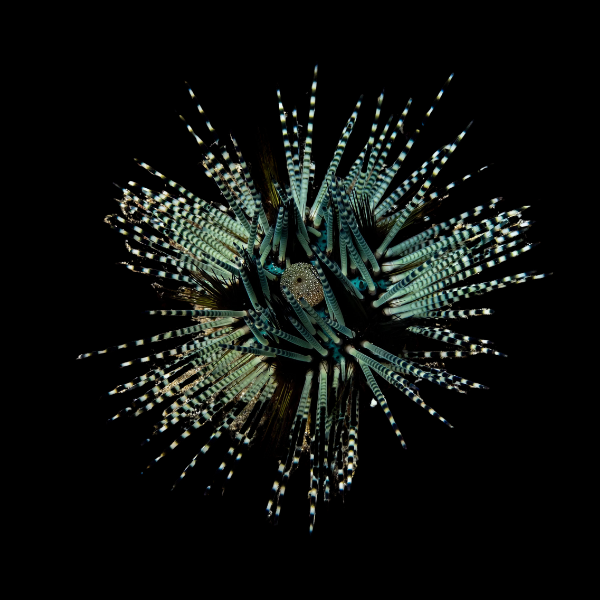
The Banded Longspine Urchin is a striking echinoderm with alternating dark and light banded spines, often appearing black-and-white or brown-and-cream. It typically has two types of spines:
-
Long, slender, banded primary spines.
-
Shorter, finer, often reddish or brown secondary spines covering the body.
This urchin is not only beautiful but also venomous, delivering painful stings if handled carelessly. It plays an important role as a nocturnal grazer, feeding on algae and detritus while hiding in crevices during the day.
Origin:
Found throughout the Indo-Pacific, especially in coral reefs, lagoons, and rocky coastal areas.
Feeding:
-
Primarily feeds on algae and detritus.
-
Will graze on live rock in aquariums.
-
Can be supplemented with dried seaweed (nori) or spirulina if algae is scarce.
Tank Mates:
-
Reef safe – does not eat corals.
-
May accidentally knock over loose corals or rockwork due to its long spines.
-
Best with peaceful tank mates; predators (triggerfish, puffers, wrasses) may attack it.
Aggression Level:
Non-aggressive, but venomous – spines can break off and cause painful stings.
Experience Level:
Intermediate to Advanced – requires careful handling, stable water quality, and a mature system with algae growth.
Water Parameters:
-
Temperature: 74–80°F (23–27°C)
-
pH: 8.1–8.4
-
Salinity: 1.023–1.025
-
Tank Size: 100+ gallons (due to large size and roaming behavior)
Unique Features:
-
Distinct banded spines give it a zebra-like appearance.
-
Has two sets of spines, unlike most urchins.
-
Nocturnal – usually hides in caves or crevices during the day.
-
Venomous – defensive stings can cause burning pain and swelling in humans.
✨ The Banded Longspine Urchin is one of the most striking yet hazardous sea urchins for aquariums. It’s reef safe but best suited for experienced aquarists due to its size, venom, and tank space needs.